Showing posts with label rambling. Show all posts

Tuesday, May 27, 2025

Plastic Fantastic: or "It's Brass, Jim, but not as we know it"


So, I bought the ZO Next Generation ABS Trumpet, ("Screaming green"), and it arrived in the mail yesterday. I really like it, which is potentially a problem.

You see, I secretly harbour a desire to own an entire brass band (well, the instruments, not the people), but have been kept from doing so because it's really quite expensive to buy actual brass instruments and I'm pretty rubbish at playing them.

Plastic "brass", on the other hand...

The first brass instrument I ever bought was a fifth-hand cornet, which I taught myself to play. When I joined a band programme to get "proper" lessons, the guy told me I'm not suited to higher brass and issued me a baritone horn. 

The barry is a nice sounding instrument (a baritone is to a euphonium what a trumpet is to a cornet – a "brighter" instrument in the same register), but if you are the kind of person who struggles to keep time, it's one of the worst instruments to play in a brass band, simply because it's almost always grace notes and filler. I've previously described Second Baritone as being the fourth finger on the left hand of a piano player. I can't handle a six-bar-and-three-quaver rest and then coming in for a few notes of harmony. It just doesn't work – especially when practicing on my own at home.

So after some tooing and frowing, I realised playing in a band was not for me.

In a fit of "I have too many instruments I don't play", I sold my cornet. But I missed having brass in my life, so I bought a third-hand alto/tenor horn. Which sounds just lovely. I think, honestly, of all the brass band instruments, the Eb alto/tenor horn has the most beautiful sound (closely followed by it's higher saxhorn sibling, the flugelhorn). There's something utterly gorgeous about instruments in that register. Think of it as being like an F French horn, only you play it like a trumpet (and it's ever-so-slightly deeper).

But it's not something I can just leave lying around. You can't just leave a brass instrument "out", because it's not good for it. When I'm not playing it, I have to put it away. In a bag, in a cupboard. Which means it largely doesn't exist. It's a rare and special event when I both remember I have this instrument and have the urge to pull it out and play it.

A little while ago, as part of an experiment, I bought a jHorn. This is a bizarre plastic monstrosity that is smaller and lighter than a trumpet but the same pitch as a barry or a euphonium (and you can change it from Bb to C, if you so desire).

Nuvo's jHorn comes in several colours that will get dirty far too quickly, and black.

The jHorn is an interesting bindingle of a thing, in that it's kind of like playing the bagpipes, but in "brass" form. If you've ever tried playing the bagpipes, you'll know what I mean – it's a blunt instrument that requires a lot of control to play well.

The mouthpiece it comes with gives you three options, all of which are terrible, and the horn itself makes you work to keep your note steady. It's marketed for children because it's actually compact, light, hard to damage and pretty quiet. I can play the jHorn in my living room at night-time without a mute and have no fear about disturbing the neighbours, which is why I bought it.

However, it's a real challenge to play "not horribly". As someone who plays at the standard of a fifth-grader who just started learning to play a few months ago, I expect most children would really struggle with it.

But, it works. I can leave it lying around my living room, pick it up whenever I feel like it, have a bit of a play, feel I'm actually improving (by virtue of practicing more often, I guess – who knew?) and feel completely relaxed about the whole thing. So I play this godawful contraption far more often than I ever practiced my actual brass instruments.

After much umming and ahhing, I decided to give the ZO instruments a try. I've been eyeing off the plastic euphonium* for some time, but I've been hesitant to spend too much money on something that might be, well, crap. The jHorn only cost me $250, so I don't mind that it's a bit terrible. Yes, $700 is considerably cheaper than the $3000-ish it would cost me to by a real euphonium, but it's also not money I want to spend on something I'll never use because I hate it.

Well, I found a place that was selling the ZO trumpet for a little over $200 and thought it was as good a chance as any to see what the ZO ABS instruments were like. And... I like it. I feel like the biggest problem with the instrument is the person playing it, which is a really good thing.

But it's also a really bad thing, because ZO has all of the concert brass instruments in the Next Generation series. None of the Eb jobbies you get in a brass band, just the Bb numbers you'd find in a concert band, including a double French Horn. And they are significantly cheaper than buying the brass versions of these instruments...

If these people come out with a sousaphone, I don't think I'll be able to stop myself.


*If I ever go back in time and start a garage band in the 90s, I'm going to call it Plastic Euphonium.

Tuesday, January 18, 2022

Shredder. Or, a chunk of time you're never getting back

This story is really boring and entirely pointless, but I swear every word is true.

I bought a new shredder the other day. I wanted to get one for my garden. Not a garden shredder, mind (I already have one of those), but a paper shredder. It will live in my office and shred paper work.

You see, I have a compost tumbler. I've become somewhat obsessed by it. I never thought I'd become one of those people who evaluate everything in their lives for its compostability, but there you are. I can't see "rubbish" anymore without thinking "I wonder if that will compost?" I now spend hours on "Compost This!" style websites. I have borrowed books about composting from my public library. It's a bit sad, really, but we all need hobbies.

I need more paper in my compost - it's too "greens" heavy and needs more "browns". A balanced compost bin needs a combination of nitrogen (from "greens" - vegetables, grass clippings, egg shells, teabags and the like), and carbon (from "browns" - dry fallen leaves, straw/hay, dry mulch... and shredded paper) in order to do the composting thing. Without a good balance of greens and browns your compost will either be too moist or too dry to break down properly.

There are a lot of different "ratio rules of thumb" out there in terms of how much of each you should have, and I'm just getting into composting, so I'm not going to hitch my wagon to any of them and swear "It must be so!", but I do like the advice that it should look nice and loamy. Observe and interact! If it looks too damp (rather than just "nicely moist"), add browns. If it looks too dry, add greens.

Well, my compost needs more browns. And I need to get rid of my paperwork. Sounds like I need a shredder!

Except I already have a shredder. It's a strip-cut shredder, which means it doesn't shred the paper into small enough pieces for the type of compost tumbler I have.  I had to keep ripping up my shredding by had to make it small enough to go into my compost bin. I found this time consuming, so I wasn't doing it. Instead, I was just growing an ever increasing pile of paperwork that needed shredding. Also, I didn't think it would work for things like newspaper and paper bags, so I didn't even bother trying. Once again, I was ripping it up by hand, and therefore just generating a pile of paper I was "getting around to at some point".

So I thought it was high time I bought myself a shreddier shredder. I did what all good librarians do, and engaged in a spot of research regarding shredders. It turns out there are three types of shredder - strip-cut, cross-cut and micro-cut. Given that some of the work paper and dried leaves does in a compost bin is adding some gaps for air to circulate, it seemed to me that cross-cut was probably going to be more compost friendly than micro-cut, which might compact down too much and require more breaking up (because even though it's in a tumbler, I still find myself having to stir it up regularly - possibly because it's too damp and needs more browns).

As I was learning about "run time", "rest time" and "security level", I came across the statement that strip-cut shredders were "entry level shredders" - which seems like a bizarre idea to me. What the dickens is "entry level shredding"? Is it for people who are thinking of taking up shredding as a hobby, but aren't really sure they want to commit just yet? Would anyone who has actually read about the different security levels of shredding choose a strip-cut shredder over a micro-cut shredder for any reason at all?

And then I remembered two things: a) I bought a strip-cut shredder precisely because it was cheap and I didn't know if I was going to be all that dedicated to shredding (I saw it on special in a Big W and thought "Ooh, a shredder! May as well give it a whirl"), and b) I compost for a hobby, so who am I to judge? Also, I shred for the composting, so I guess I kind of shred for a hobby, too. 

Look at me, leveling up my hobby shredding game!

Friday, July 16, 2021

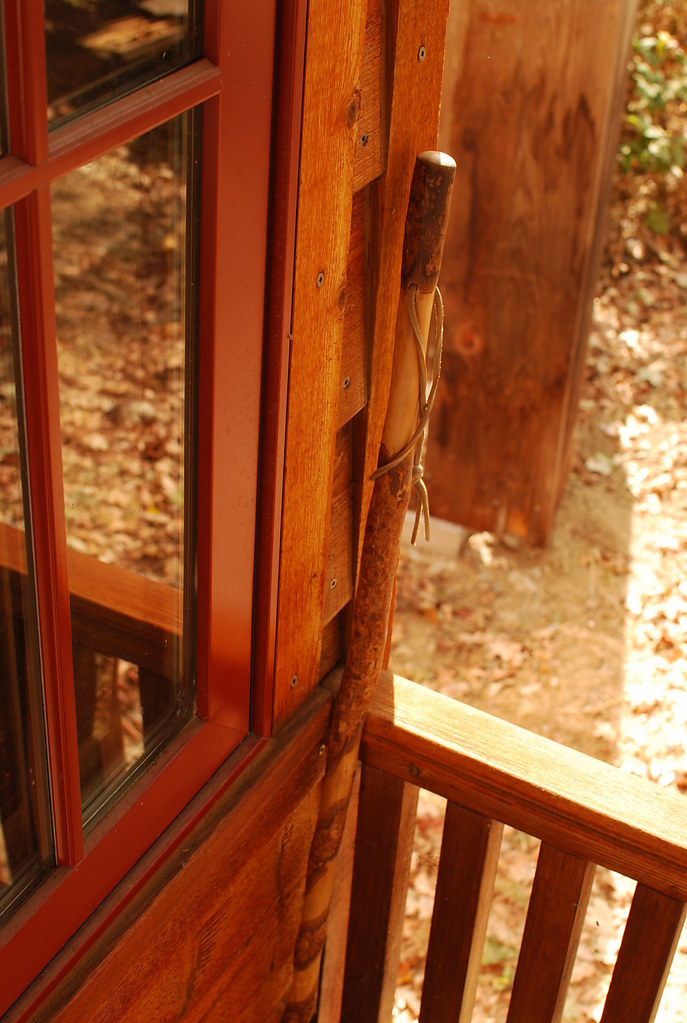
A knife and a stick

"walking stick" 
by nicolas.boullosa 
is licensed under 
CC BY 2.0

I was chatting with a martial arts instructor the other day when he mentioned that most martial arts schools involved using a sword at some point in their history because they came out of a time when everyone carried swords. It was a simple observation, but it got me thinking.

Well, I suppose it's true enough that everyone who was of the right class to study martial arts was probably also in the right class to carry a sword around. As a fencer,1 I'm well aware that a) swords are cool, and b) traditional swordsports are traditionally for rich people. In this day and age you can borrow equipment from the club, so you don't have to be rich to participate in swordsports (but being at least middle-class helps - especially if you want to buy your own gear), but you can still tell that sports like fencing came from the likes of the idle rich.

Working class people would never wear white clothing for a vigorous physical activity. They know what it's like to do laundry. Plus everything costs money. You can't make any part of it yourself in your shed, you have to pay some skilled craftsperson to make it for you.

Now, I come from a long line of fishermen and farmers.2 My ancestors did not carry a sword around - even when it was that time in history when people did carry swords around. A working man hasn't got the time or inclination to carry around a heavy chunk of metal that doesn't do anything useful apart from defending your honour. 

No siree. Fishermen and farmers would be carrying around a knife and a stick. A knife is one of the most useful things on the planet, and you can use it to defend your honour as well if push came to shove. Same with a stick - a good stick is worth it's weight in gold. You can do a lot with a stick. Swords on the other hand? Pfft! They're the wrong shape and size for almost anything you'd want to do except fight. 

In times of war, the working folk might need a sword, but (especially in Europe) they'd probably have a short sword (really just a big knife) because they spend their days working, and haven't had time to learn how to use one of those big swords with any kind of efficiency. Most likely, they'd get an axe, a spear or a pike to play with - much closer to tools they've actually spent time with.

But really, for the vast majority of people throughout history, you were better off learning how to fight with a knife and a stick. Or, perhaps, learning how to defend yourself with a knife and a stick, or defend yourself from someone trying to attack you with a knife or a stick.

And it's interesting to note that in modern days you will probably never be attacked by someone with a sword (unless they're a meth head with a decorative katana set that they've stolen from the last house they broke into), but people do still go around threatening other people with knives. I'm telling you, knives are just more useful than swords all round.

I know a number of martial arts have working with staffs and disarming people with knifes as part of their programmes, and I'd like to know a bit more about that. But what I really want to know is why this sort of thing doesn't seem to have come up in Europe? Why isn't there an ancient tradition of elegant and efficient fighting techniques that involve using your stick to disarm someone carrying a knife that has risen out of thousands of years of peasant farmers carrying sticks around while brigands and vagabonds ran about with knives, robbing people on their way to market?

Is it just that it would have been a peasant art and therefore not considered worth perpetuating? Is it because fishermen and farmers were too damn busy working and didn't have time to come up with an elegant and efficient way to fight and defend themselves?3 Or is it because Europeans just didn't have that same kind of elegance and efficiency that you see in a lot of the Eastern arts in general?


1. I'm going to keep calling myself that, even though I don't currently fence, until I completely give up on the idea of going back to fencing

2. Actually, I come from a long line of women (from fishing and farming communities), and they definitely weren't carrying swords. Knifes and sticks? Probably. Knives and sticks are very useful, and these women worked.

3. Probably.

4. I somehow managed to write this entire post using the word "knifes" instead of "knives". I don't know why. I think I caught them all and fixed them.

Wednesday, December 2, 2020

So, I met a bird

 I dropped my mother off for an appointment near a park today, and my grand plan was to sit in the park and read through some documents while I was waiting to pick her up again.

This park is the oldest park in the city, and for many decades it has had an avery in it. Not always the same avery, and for a while now the avery I remember from my childhood has been semi-abandoned. The plants are still there, but the birds have been gone for a while. There have been signs saying they were "planning what to do with the avery" for a while.

Well, there is now a new avery. They ripped out the rose garden and put it there. The last time I visited this park there were signs saying they were "planning what to do with the rose garden", so maybe they're going to tear down the old avery complex and put a new rose garden there. Who knows.

I suppose the garden curators do.

Anyway, two things struck me about this new avery. One was the sign on the side saying it had been constructed in 2019. Now, my memory of this year is hazy at best (to be honest, my memory of any year is hazy at best) but I would have sworn I visited this park earlier in 2020, and there wasn't an avery here then. But maybe it really has been over a year since I last came during daylight hours (I went to a play in that park one night a few months ago that was staged on the opposite side of the gardens to the avery, so I wouldn't have noticed it then).

The second thing that struck me was the mystery bird in the lorikeet enclosure. This fancy new avery had three enclosures with native Australian parrot species in each enclosure. One held cockatiels and galahs (they each had signs on the side of the enclosure), another held a sulpher crested cockatoo and a long-billed corrella* (also listed on the side of the enclosure), and the biggest one held blue mountain lorikeets, according to the signage, and nothing else.

Except there was something else in the enclosure. Something that definitely wasn't a blue mountain lorikeet. Something like this:

Image by JJ Harrison, from Wikipedia

If you haven't seen a blue mountain lorikeet before, I assure you they do not look like that.

While I was trying to find out what this bird was, I noticed a giant spider in the same corner of the enclosure the bird was sitting in, and I walked closer to admire the spider. It was one of those massive orb-weavers that eat large insects and small birds, and I spoke to the spider:

"You are magnificent, aren't you?"

I don't know if the bird thought I was talking to it, or it noticed I was talking about the spider and wanted to engage in a conversation with someone who wasn't one of those idiot screetchy lorikeets, but it started chattering away to me.

We had a good natter for a few minutes, and I found myself saying I would happily take it home to have the run of my house, if I could. It seemed quite interested in this offer, and the tone of the conversation actually shifted slightly. (This is pretty much how I got my cat, actually - she engaged me in a conversation and I thought "Well, this cat seems pretty cool"). But then I mentioned that my house is not as light and airy as the avery and I probably wouldn't be allowed to take any of the birds home anyway, and the bird lost interest in me and went to attack the sprinkler system.

Still, it was fun to actually meet a bird at an avery and have a bit of a conversation. Most of the time you just get accosted by bored cockatoos who are driven half mad by humans who can't provide much entertainment beyond bad cockatoo impersonations.

I found out later on that this beautiful creature is a crimson rosella. You would think I would recognise it from the side of the tomato sauce bottle I've been using for years,**,*** but I didn't. It really has the most lovely plumage - especially on its wings. If you ever get the chance to chat to one, you should.


*These birds look vaguely like a zombi galah. They're kind of cadaverish.

** Rosella is a brand of condiments in Australia. They have a rosella in their logo, which is on the side of all sorts of bottles and jars in my cupboard.

*** Update! The Rosella condiments have an eastern rosella as their logo, not a crimson rosella, so I feel less dopey about not recognising it now.

Thursday, October 22, 2020

Sometimes, When You Wear the Scarf

 One of my favourite television shows when I was in university (for my first undergraduate degree) was a short-lived puppet-based show called Don’t Eat the Neighbours. 

I’ve gone through a number of periods in my life when I was able to watch children’s television during the day. There was my own childhood, of course, and then I watched TV with my younger cousins when I was a teenager, and saw the children’s television of their era. My first degree in the late 90s/early 2000s, and my library qualifications in the mid 2000s… All told I’ve got a good 20-30 years worth of children’s television under my belt. These days, thanks to catch-up TV, I’m starting to get another dose, as I watch new classics like Bluey when other people are watching crap like The Bachelor.


My first degree, though, was probably the biggest period of children’s television watching outside of my own childhood. My timetable was such that I really only had time to watch TV during the morning, when mothers plonk their kids in front of the set while they try to get the house wrangled into some sort of order. I became such a fan of the first series of Hi-5 that I bought one of their cassettes to play in my car. To this day I can still remember most of the lyrics to “Boom Boom Beat”. 


I guess I was old enough to have kids of my own (other girls my age started when they were 19), but I didn’t. I just refused to accept the idea that not being or having a child meant you couldn’t enjoy things that had been created “for children”. I also have a deep an unending love for picture books, which I often borrow from the library. I’m taking them home for myself to read, even though there are no children in my house, because I enjoy them.


Don’t Eat the Neighbours involved a family of Canadian wolves who moved to England and found themselves living next door to a family of Rabbits. Both families were headed by single parent fathers, which was interesting, and most plots involved the interaction between a predator and a prey animal in a situation where it was both expected that there would be an altercation, but also kind of rude and unnecessary. There was also a fox, voiced by Simon Callow, who was clearly both gay and highly interested in the father of the Wolf family. It was never quite clear if Wolf noticed, or just thought Fox was his new best friend. They both tried to catch Rabbit (and his best friend, Terrapin) whenever possible, and Rabbit and Terrapin spent their days out witting them.


The kids in the families got along well with each other, had no interest in their parents’ petty feuds, and would either thwart the adults’ plans or just do their own thing and ignore them.


At one point, the wolf kids were asking Fox a question, which lead to the following exchange:

FOX: Do I look like your mother?

WOLF CUB: Sometimes, when you wear the scarf.


This really stuck with me. It stuck with me so much that I used to say it all the time. Whenever my answer to a question was “sometimes”, it just seemed perfectly natural to follow it up with “when you wear the scarf”. It became one of several quotes from obscure children’s television shows that I used to say so often in my university days, that by the time I left uni I had several friends also quoting those shows regularly – even though they had never seen them.


Which is fun, I think. The fact that I was constantly quoting things that no one had seen became irrelevant after a while. They stopped caring about the fact that they didn’t share the TV shows with me, because after a while they simply shared the catch-phrases with me, even though they were divorced from their original settings.


That’s kind of how catch-phrases work, I guess. I, too, quote things I’ve never seen, because I’ve come across those quotes elsewhere and picked them up along the way. Sometimes, I picked them up after they shifted in meaning slightly from the original. Take “I say it’s spinach, and the hell with it.”


Ah, but perhaps that’s another pointless, rambling story.


Monday, July 20, 2020

This is not 108

A thought recently popped into my head that blew my mind a little.

Facebook was advertising Mala beads to me, which have 108 beads. Some people say it's because 1 has a certain meaning, 0 has a certain meaning and 8 has a certain meaning.

But I suddenly realised (late to the game, I know, but maths isn't my strength) one hundred and eight and one-zero-eight aren't the same thing.

One is an amount, the other a sequence or a series. You could replace 108 as a number with a word that means one hundred and eight things (I shall call it "a shiffle" - as in, a set of Mala beads consists of a shiffle of beads, and a shiffle of onions is way too many onions). Where as I could replace the sequence 108 with any series of words or symbols (starfish-apricot-tractor).

It gets even further away from numbers when you think of 108 as being (as the yoga magazine I read recently suggested) that it's sort of a sequence of actual symbols. A solid line for ultimate truth, A circle for inherent emptiness, and an infinite loop for timelessness. Or the classic binary sequence of 1 (everything) 0 (nothing) plus infinity (it's an infinity symbol on it's side). So you could have exactly three beads and it would still "mean" 108.

108 and 108 (and, possibly, 108) are two (maybe three) completely different things that just happen to share the same three figures (and the same set of beads).

And now I'm going down a Derridan wormhole if signifier/signified, phenomenonolgy vs structuralism crap, and I really need to get more sleep.

Ceci n'est pas une pipe.

Sunday, December 23, 2018

The trouble with decluttering

Part of me wants to be a minimalist. I look at my stuff and think, "that's too much stuff - I need less stuff."

But the sad fact of the matter is that my "clutter" can be largely divided into two groups:

1. Things that are actually useful, it's just that I haven't used them (yet)
2. Things I bought for hobbies

It's the second group that causes the most angst.

You see, I haven't given up hope. Sure, I haven't played that concertina/finished making that stuffed bear/actually used my whittling equipment to whittle anything for over a year (maybe longer). Heck, I have a tent (it's a really good tent) that I have literally never used - and I bought it over five years ago. But I still want to do "that thing". I want this to be a hobby that I actually do, and there's always the possibility that I'll be the person who does that thing if I have the stuff to do it with.

So, I have paints for the water colour painting that I don't do. I have a lovely chip-carving set for the chip carvings I have never made. I have dancing instructions and music for the Scottish Country Dancing I haven't done for years. I have instruments I was once passionately in love with, that I've barely looked it for an awfully long time. And I have a bag full of reclaimed material so I can practice making stuffed toys (even though I've been working on finishing one small bear for the past year).

I want to create, make, play, do... But I don't actually do any of these things.

Technically, it's all clutter. Just crap filling up the corners of my house.

But every time I go to clear some if it away, I remember the dreams that brought it into my house in the first place. I still have hope that "one day" I'll be the person who does that.

One day.

Thursday, November 29, 2018

Don't eat the dieffenbachia

Aspidistra elatior by Digigalos
CC BY SA
So I finally started the forest.

For quite a number of years now, I've been thinking: "My workspace needs green things." But thinking about how much I'd like a few pot plants around the place and actually making the effort to get them have been two different things. I have been doing the former quite regularly, but the latter? Not so much.

But the other night I finally said to myself: "Bunnings is open until 9.00pm, dangit - go get an aspidistera."

Some months back I bought a lovely pot plant stand for my house, and I went looking for houseplants to keep on it. I did some research for "okay-to-be-indoors, reasonably-hard-to-kill, won't-poison-pets" plants, and aspidistera came in a winner. Aspidisteras and peperomias. But when I went shopping for plants the Bunnings I went to didn't have any aspidistera. I'm not sure how that was possible, because aspidisteras are one of the most common houseplants on the face of the earth.

They also have a really fun name to say: "Aspidistera". Fit it into a sentence and it makes you sound somehow more civilised. "Oh, yes, you'll find that on the coffee table next to the aspidistera."

So, long story short, I went home that day with a couple of peperomia and a trio of ferns, wondering how long it would take for them to show me that I don't know squat about keeping houseplants alive. So far, one of the peperomia is doing quite well (the other is struggling a bit), and one of the ferns is going great guns, while the other two are busy telling me I should have put more thought into my potting mix. They are communicating their displeasure through the medium of dying.

And yet, even though my track record with "keeping plants alive" isn't great, I still want to live surrounded by them.

So I went to Bunnings (a different one) to look for apsidistera. I found some, but instead of buying a small aspidistera plantation (which was my original plan), I suddenly went on a houseplant frenzy and just bought a bunch of things. Aspidistera, dieffenbachia, fikus, boston fern and peace lilly. The fern and the peace lily also have the fun names to say (nephrolepis and spathiphyllum, respectively), but if you say "aspidistera" there's a chance people know what you're talking about. If you say spathiphyllum they think you're having a stroke.

Both the dieffenbachia and the spathiphyllum came with strict instructions to not eat them. Now, I know from my research that they're not safe around pets, which is why I didn't buy any for my house (even though my pet currently doesn't live in my house - long story), and I'm glad they put that information on the plants themselves - but I'm finding the very general warning quite amusing. "May be harmful if eaten". It kind of implies that anyone in the house might give it a crack.

I suppose, in some houses, they might.

Right now I'm surrounded by green things that aren't dead yet. It's only been a few days, but I'm hoping they stick around for a while, because I like my little forest - it makes me smile.

Monday, October 15, 2018

Finding something in nothing (Or: A strange and slow crisis of faith)

By Michael Rivera - Own work
CC BY-SA 4.0
My mother was visiting my house the other day (a rare occurrence these days, as she doesn't like driving at night) and she picked up a few of the books I've been reading lately.

"If I didn't know any better," she said, "I'd think you were turning unto a Buddhist."
"I'm starting to think that myself," I replied.

A little over a year ago I was sitting in a Thai restaurant (where all good life-changing moments happen) and reading the decorations on the wall while waiting for the food to come. I noticed how similar the statements attributed to the Buddha were to things said by Jesus and/or Solomon, and it suddenly occurred to me that I knew absolutely nothing about Buddhism.

All I knew was a throwaway line handed to me by a teacher at the church-run Christian school I went to - that Buddhists worship "Nothing".

Now, I realised ages ago that the kind of Christianity that was on display in that particular denomination wasn't for me. The more closely I looked at it, the more I felt that it was propelled by wilful ignorance and arrogance instead of openness and a desire to learn and grow. Now, this denomination may be exactly what someone else needs in their spiritual walk, but I felt like I was constantly finding things I wanted to talk about that were on some sort of list of things that I shouldn't want to talk about if I was a "good Christian". Stick to the party line, and don't ask questions.

What I hated most about that denomination was the fact that they kept saying "oh, we're not religious, we just have faith" - which sounds great, but was a load of crap. They were totally religious - and there was nothing wrong with that - religion is a framework that we use to build a community of faith. They just wanted to feel somehow superior to other denominations, so they tried to use "religion" as a way of telling the difference between "us" and "them" - and this was one of many things you weren't supposed to call them out on, even though it would have made us all better Christians if we were called out on it and became more self-aware.

I was raised into this version of Christianity, but I didn't belong in it. I'd felt that even as I was getting more and more involved in the church and youth group. Eventually, I just had to leave. I found Anglicanism, and that kept me in the Christian church. It was, basically, as far away as I could get from the denomination I had left without becoming Orthodox or Catholic. I loved it. I was the drink of water I needed after feeling like I was drowning in sand in my old church. I even considered becoming a priest at one point... only there were a few things that I really didn't agree with (like baptising infants), and I found myself confronted by a rather important question:

Can you be a member of a particular faith if you don't believe in what members of this faith are supposed to believe in?

And then there's a little issue that I noticed some time ago: I actually don't buy the afterlife as Christianity describes it. I've never been interested in heaven - and I've never heard a description of it that makes me think "oh, that's the point - I can get behind that." This whole idea that you live an incredibly short life in this plane of existence in order to work out what you are going to be doing for the rest of all eternity sounds like crap. It doesn't sit comfortably with me and I do not like it at all. If you gave me the choice of possible after-life options, I'd take another short-term option, followed by another, if that's okay. One short life followed by *forever* is not something I actually want.

I know that what I want and reality are not the same thing, but the afterlife is something you have to take on faith. Having faith in something you don't actually want to believe in is a bit odd, when you think about it.

I've also been noticing that a lot of the concepts and teachings I associate with "Christianity" weren't actually taught by Jesus. They've been "extrapolated" over the centuries, and apart from the Quakers, there aren't that many people saying "hang on, let's get back to basics, shall we?"

And then there's that moment when I was reading a passage in the Old Testament, thinking about how it applied to my spiritual walk (which is what I do - or rather, did), and an epiphany hit me. I realised as plain as day that it wasn't written for me. It was written about some ancient Israeli dude. I am not an ancient Israeli dude. I can learn from what this ancient Israeli dude experienced, if there is something to learn from it, but there is no *good* reason for why I should be learning from his experiences more than anyone else's.

I've been holding on to Christianity because I cannot fathom a universe without God, and Christianity is the way I've come to know God and think about him. But I feel like I'm holding onto the bar of one of those playground roundabouts - like it's actually flinging me off, and the more I look at Christianity, Christians and the Bible, no matter how much I want to move towards the centre, I'm actually finding myself closer and closer to the edge.

I started reading about Buddhism to fill a gap in my knowledge, but I'm at a point that I have to admit I'm being won over. I've just read so many things in either the sayings attributed to the Buddha or the writings of other Buddhist monks and teachers that made me say "Yes! Exactly! That makes so much sense!" or "Oh, man, I needed to hear that - if I'd heard it back when I was younger it would have made a world of difference."

When I was a teenager and in my early 20s, I struggled with bouts of depression. Not as severe as others - I think "mild to moderate" is the term - but they were still rather devastating at the time. Looking back on it now, I realise that the things that helped me deal with that are actually part of the Buddhist way of approaching life, and if I had known more about this approach to mental health at the time it would have helped me immensely.

The theology of the various streams of Buddhism aren't doing anything for me, but the philosophy, the world view and the approach to being a human being in this life are ticking a lot of boxes. Sometimes I never even knew the box was there (and empty) until it was ticked. I'm arguing with Buddhism a lot. I'll read something and think "well, that's complete nonsense". But the beauty of Buddhism is that you're not supposed to swallow it hook-line-and-sinker. You're supposed to question it, challenge it and take what is wholesome and leave the rest (something that is actively discouraged in most versions of Christianity, as I've encountered it).

And I've often found that the reason why I've disagreed with something I've read is because I'm coming at it from a particular angle and interpreting it a particular way. When I look at it from a different perspective, or change my reference points, it gives me a lot to think about. I feel like, for the first time in a very long time, I'm actually growing.

But I still hold to the teachings of Jesus (which, believe it or not, are not incompatible with Buddhism as a philosophy) and I still hold to God - I still cannot fathom a universe without "My Father In Heaven", if you know what I mean?

So I've been having an incredibly protracted crisis of faith. It has accelerated in recent years, but it has been going on for a very long time, when I think about it. I no longer feel entirely comfortable calling myself a Christian (even though I kind of still am) as I have one foot out the door and the rest of me is facing that direction (some days I barely have one foot in the door), and I'm not yet comfortable calling myself a Buddhist (but, man, I'm not far off).

The really annoying thing is that the priest at my church keeps coming back to sermons about making decisions and commitments to your faith ("choose you this day, whom you will serve" and all that), and I really wish she'd stop. I don't want to stop attending church because I feel like it's going to be really hard to rebuild my relationship with Christianity if I'm not spending quality time with it, but right now I'm at a point in my life where if you say "choose one", I'm really not sure which one I'd choose... but I have my suspicions.

Wednesday, April 11, 2018

A Matter of Time and Underwear


When I’m in the mood for killing a few minutes with some mindless television, I don’t go for soap operas or “reality” TV – I turn to ads for exercise equipment and fitness programs.

I don’t know what it is about these ads, but they catch my attention and hold it in a way that similar ads for air-fryers or non-stick frying pans just can’t. Whenever I flick onto one of the ads-that-go-on-forever channels (i.e. home shopping whatnots), I’m always disappointed when someone is blowing a crepe out of a frying pan instead of showing Chuck Norris.

I love Total Gym ads. I also love Bowflex ads – although I preferred the old machine that had the whole “bow” thing happening; the glorified elliptical trainer they have at the moment is boring in comparison. Oh, and TapouT XT ads are a hoot, but they don’t have a patch on the ads for the Brazilian Butt Lift. I was always incredibly happy whenever I came across the BBL ads on the home shopping networks – but mostly because the way they referred to one’s derrière as a “boom-boom” was hilarious.

I’ve never actually bought any of these products, I just love the ads. I will confess that I did actually buy some DVDs for Tae-Bo.... but this was many, many years after Tae-Bo was a thing, and I bought them because I found them in a shop for a really cheap price. I wanted to see if I was the kind of person who would actually use an exercise program on DVD (you know, just encase I decided to go for the BBL DVDs). Turns out I’m not.

Glad I didn’t buy them at the height of their fame for 4 easy monthly payments of whatever it was back then.

The thing that struck me recently (when I saw a Bowflex ad straight after a Total Gym ad) is the fact that they all try to market their machines/programs as time savers. “Achieve results in less than 10 minutes a day!”

For some reason, they have decided that time is the biggest reason behind people not exercising. They seem to think that, if people can spend less time doing that pesky workout thingy, they might be more willing to buy the workout thingy.

But the fact is, we’re not not exercising because we don’t have time. Of course we’ve got time. We’ve got oodles of time. I just spent 20 minutes watching an ad for Total Gym.

If I’d just grabbed a skipping rope and skipped for the entire time the ad was running, and maybe threw in some plank exercises during the Bowflex ad, I’d see some pretty impressive results if I kept that up for a few weeks – and all for the low cost of one monthly payment of $3 to get the skipping rope from KMart. But wait! If you order now, we’ll also throw in the floor of your own house (normally valued at nothing) for free!

No, the main reason I don’t exercise much is I’m too lazy to get changed. I don’t want to get hot and sweaty in the clothes I’m wearing, but I really can’t be bothered changing into suitable clothing. And if I did make the effort to get changed, after I finished exercising I’d have to get changed again – or sit around in uncomfortably sweaty underwear for the rest of the evening. I’m certainly not going to do that for “less than 10 minutes a day!” – what would be the point of that?

Total Gym, if you come up with clothes and underwear that I can exercise in, and then just loll about in for the rest of the night without feeling sweaty and stinky, you’ll have my full attention.

Sunday, November 20, 2016

Bonsai!

I drove past a bonsai club meeting on the weekend, and saw a bunch of people putting their trees back into their cars (obviously the meeting was over). I thought it must be nice to be able to take your pet tree to a play date with other trees, but wondered what the trees thought of it all. Were they happy to have the chance to hang out with other trees who had experienced similar things, or would a bonsai tree be more of a shy, retiring type who resented being forced to socialise with others? Considering bonsai trees have their growth deliberately stunted, perhaps they regard it as more of a support meeting with other "suffers". I briefly thought of taking up bonsai, once. Then I worked out it was a thing for patient people, and acknowledged that I do not belong in that category.

Friday, October 16, 2015

Things that keep me awake at night: Beans

Like many people who have difficulty sleeping, I find I lie awake at night have thoughts of deeply important and worrying things run through my brain.

Like that night a few weeks ago, when I was still awake a few hours after going to bed, pondering the following deep philosophical question:
How did soy get to be The Bean?  Why is it the foodstuff that replaces everything?  
You think of any foodstuff you want to replace, and someone is probably using soy to replace that.  We probably have soy in more foodstuffs now than any other ingredient.  Why?  What's so special about soy?
Can you make milk out of other beans?  If you can, then why don't you?  Like butter beans.  Butter beans sound like they'd be a perfectly legitimate fake-milk ingredient.  You could make butter out of butter beans, I warrant, and people would probably think "Oh, okay" because the word "butter" is legitimately involved...
Actually, I've just looked it up, and butter beans are in the Phaseolus genus while soybeans are in the Glycine genus, so maybe they don't have the same properties.

But still, the question remains:  How did soy become The Bean, and why don't we use other beans in a similar fashion?

I'm telling you, this stuff is deep.


Friday, July 10, 2015

General dissatisfaction is my special skill

A new(ish) colleague from another town is coming to visit in a few days, and we've been tasked with chatting to her about what we do and what sort of things we're particularly suited to helping with.

The person coordinating this visit said something along the lines of "just tell her what you're good at."

She then paused for a moment, looked up with a gleam in her eye, and asked, "What *are* you good at?"

It's a surprisingly hard question to answer.  Just stop for a moment, and imagine someone turned around and asked you that question.  What's one of the first things that pops into your mind?

If you could set aside any and all social conventions concerning modesty and what you think people expect of/from you, and you had the opportunity to stand up and declare to the world something you honestly believe to be a special skill that you have (whether you utilise it or not), what would you say your "special skill" is?

Being "churched", I often come across references to the parable of the talents.  Jesus tells a story about three servants who are given talents (coins) by their master while he's away on business.  The first servant is given ten talents, and he invests the money and earns ten more.  The second servant is given five talents, and he also invests it and doubles the amount.  The third servant, given only one talent, is too afraid of stuffing up - so he buries the talent in order to give back exactly what was given to him.  Not a penny less, but also not a penny more.

The master comes back and rewards the two profitable servants, but throws the cowardly one out onto the streets, then gives his talent to the servant who had the ten talents to begin with.

The "moral" of this story is what has become distilled into the saying "the rich get richer and the poor get poorer" (although I can't say that's what Jesus actually meant).

This parable might very well have been an economic treatise, but if you give a Christian a parable, they're going to find something warm-and fuzzy buried inside it.  This is why we tend to latch onto the word "talents" and talk about how, when it comes to the metaphysical gifts we've been given, we need to use them or lose them.

Whenever I come across this parable I find myself wondering "What *is* my talent?  What can I do well that I could be putting to good use?"

It's sometimes not the best trail of thought to follow, because there's a fine line between "what am I good at?" and "what am I good for?"

Depending on my level of general dissatisfaction with my life at that point, the answer I often come back to is "nothing".

I do a lot of things, and I have a lot of interests, and I'm not particularly bad at anything (except, maybe, fencing, time management and anything to do with remembering what I'm supposed to be doing), so I usually get by without noticing I'm not particularly good at anything.

Jack of all trades, master of none.

When my colleague asked the question "What *are* you good at?", my first instinct was to hang my head and say "nothing", but then something else popped into my mind.  A different answer to what I would have expected:

"General dissatisfaction."

And I realised it was entirely true.  This is my special skill - this is what I'm particularly good at:  Finding things that need to be improved.

Now, you could argue that that's not really a skill, it's just whinging.  You'd be right.

But I take some comfort in the fact that I don't just find faults - I also think of solutions.  I'm an ideas person, as lame as that sounds.  I keep nutting over "problems" until I work out what I might do if I was in a position to fix it, or produce something better.

My biggest problem is that I don't know what to do with those ideas.  I'm usually not in a position to fix it or produce something better.  Nine times out of ten, I don't even know who is in a position to do anything about it.

I offer suggestions when I can (and I can tell you from experience that most people actually aren't interested in being offered suggestions), but usually I'm just standing at my desk thinking "you know what would be really great...?"

If I was a proper inventor, engineer or developer, I'd probably be able to turn a lot of my ideas into something real, tangible and worthwhile.  Unfortunately I'm a person who writes FaceBook posts for a living (okay, that's not my whole job, but it's part of my job, so it's still true).

However, I feel a strange sense of hope, now that I've finally identified my "special skill".  The first step to putting your talents to good use is figuring out what they are.

And, if "general dissatisfaction" sounds like a pretty lame talent, allow me to rephrase it:

"I want to change the world."

It means more or less the same thing.

Saturday, February 4, 2012

Clean

Several years ago I spent a month in Brisbane during the height of the water restrictions.

This was, of course, long before the weather that lead to the floods, and the dams which eventually (and disastrously) overflowed were dangerously low at the time.

Since the water supplies were so precarious, everyone in the Brisbane area was encouraged - nay, commanded - to save water by using less of it.

Probably a good thing, in the grand scheme of things. We use too much water in our modern, on-tap lives. I've long maintained that our water usage would be much improved if we all had one tap in our back yards and had to carry all of our household water into our homes ourselves. We would very shortly find out exactly how much water we need for any given task and be reluctant to use more than necessary. If it came down to a smack-down fight between our wastefulness and our laziness, I'm reasonably sure the laziness would win.

Anyway, one of the edicts of the Brisbane council during this time was the limit of four minute showers. Everyone was encourage to shower, rather than run baths, and to complete the showering process in under four minutes.

Now, I can understand why they did that. We waste so many litres of water by letting the water just pour over us (and down the drain) while we stand around enjoying the feel of it on our skin. It's not necessary, but it's also a really hard habit to break unless suitably motivated.

However - four minutes? Really?

Okay, the theory behind it is reasonably sound: get in, get wet, soap up, sluice down, get out. Simple and effective - and something conceivably achieved in under four minutes.

I'm sure this is exactly how twelve year old boys normally approach the bathing process. I'm sure it's exactly how men in a house full of women honestly believe their daughters could approach the bathing process if they just tried for once...

However, real people don't wash like that. It's unpleasant and not as effective as you might think. Sure, it's enough to get the top layer of dirt of your skin - but it can't really clean out your pores, help remove the dead skin cells or tackle 'serious' dirt like grease and grime. And heaven help you if you wanted to wash and condition your hair as well!

I must admit I usually failed in the "under four minutes" edict. Under ten minutes? Not a problem. I can probably be out in eight and feel like I've had a real wash. But under four? That's hard.

I wasn't the only person who thought it was daft. An article I read at the time told of a woman who thought she'd beat the system by taking a shower at a fitness club - only to find out the club limited it's showers to three minutes.

A few years ago I had watched Spirited Away (fantastic film), and this article prompted me to wonder if a Japanese bath-type establishment might work in Brisbane. So I did a bit of research (not because I was actually going to open my own baths, but just because I research things I find vaguely interesting - that's why I'm a librarian) and I was surprised to discover that you are expected to be completely clean before getting into the baths.

This makes perfect sense, when you think about it. Who wants to soak in the filth that has come off someone else in the bathwater? It would be nice if we all had a bit of a shower before getting the public pools, as I have seen foreign tourists do, but Australians just don't do that. We all jump in with whatever grime we happen to be carrying around with us at the time, and then shower after our swim to get rid of the high levels of chlorine we use to kill the germs we shouldn't be carrying in with us anyway...

So, back to Japanese bathing. There's a room that is used to clean off the dirt before you go into the baths themselves for a good mineral soak. The more modern joints have showers in these rooms, but traditionally one would take a basin of water and wash from that.

Now, having come from a family where one either takes a full bath or a shower, I found the concept of this basin thing new and surprising - but absolutely obvious in hindsight. You can take as much time as you like, using a cup and cloth to run the water over your skin, and never use more water than a couple of buckets worth at the most.

You can give yourself a much better wash using a basin than you can in a four minute shower. I'm actually at the stage where I'll occasionally have a basin bath instead of a shower just because I feel like it - even though I don't currently live in a town with ultra-strict water restrictions. I feel just as clean, but I also feel strangely empowered.

It's hard to explain, but I like knowing that I'm not a slave to my plumbing. If I did ever move to a remote cabin without running water or electricity, I'd still be able to wash myself quite happily in the amount of water I could carry into the house all by myself.

I'm sure my ancestors must have washed like this, but I'm a little unclear about it all, to be honest. I know more about Japanese bathing than European, it must be said. And I have a strange feeling the British side of my ancestry probably approached it differently to the Eastern/Northern European side.

One of the things I do know about it - there was less of it. Bathing, I mean. Here in Australia we have at least one wash a day; two is not ridiculously unheard of. And yet, I know that even with running water on tap, people from Europe and the UK are more likely to wash a few times a week, rather than daily. I can't see that they would have bathed more often back when it was more inconvenient.

The things we do as part of our normal lives are fascinating, aren't they?

Saturday, November 19, 2011

Tolerance

Due to an undeniably Australian childhood, I'm probably going to end up trying to say this at some point anyway - so I may as well get it over and done with now: "suffer in your jocks!"

Okay, now that that's out of the way, I want to talk about tolerance.

My uncle has decided to name his mobile home "Tolerance" as it is the symbol of his retirement, which came much earlier than he originally intended due to his lack of tolerance.

My uncle has never been one to suffer fools gladly, but after a serious illness and a few successive economic downturns he came to realise he was no longer suffering them willingly. In fact, he was barely suffering them at all. He decided that putting up with morons for little or no pay wasn't the way he wanted to spend the next five years of his life, so he called it quits earlier than he planned in order to get to work on his dream retirement: converting a second-hand school bus into a mobile home.

His fervent hope is that, after a few years of not dealing with people who are variously morons or selfish gits trying to get things for free, he might regrow some of his tolerance for humanity.

Personally, we're not sure how becoming a nomadic hermit with only dogs for company is going to help him like humanity more, but he seems to think it's a good plan.

The other day I was flicking through my diary when I noticed some-day-or-other was set aside as the International Day of Tolerance. I didn't actually take much note of the date (I can't even remember if it's in the past or the future), but I do remember thinking: "What's the point of that? Am I supposed to find someone I usually avoid and put up with them for a while?"

It wasn't until today that I remembered the word "tolerance" is used as one of those New-Agey, P.C. buzzwords trying to encourage us to be more beige in our attitudes to the people around us. It's to do with things like "religious tolerance" and "cultural tolerance" and things like that. Somewhere along the line I'm sure it also has something to do with gay people getting married and adopting children from other races. Or something like that.

It's a strange thing, when you think about it: "tolerance". It's not acceptance, but people seem to forget that. There seems to be this strange sense that, when you show tolerance to your fellow human, you are somehow accepting them for what they are.

It's not true, of course. To tolerate something is to "put up with" it. You don't have to like it, you don't have to accept it - heck, you could still passionately hate it, if you wanted to. But you tolerate it. You let it be. You "suffer" it.

I used the phrase "suffer fools gladly" above. It uses an older meaning of the word "suffer" that really only exists in set phrases these days - like the famous Biblical quote "suffer the little children to come unto me". It means "put up with it". Sure, you would rather this thing that upsets you didn't exist or happen or be in your space, but put it up with it. Tolerating this thing may cause you to suffer from annoyance or other unpleasant emotions, but that's something you'll just have to deal with.

Tolerance is the indifference you show when you're not feeling love, but can't permit obvious hatred.

If you actually said that to someone: "I tolerate you", they would probably be highly offended. Deep down, we don't want to be tolerated, we want to be accepted and loved.

But tolerance is surprisingly useful for creating one of those things we charmingly refer to as "civilisations". By tolerating each other even if we don't like each other - by being civil even if we can't be friendly - we build and maintain societies.

Imagine how quickly our society would fall apart if we started treating "us" with the same intolerance we treat "others". It's actually not that hard to imagine - we're doing it a lot more now than we did before. It's become fashionable to blatantly hate the people who are supposed to be on the same team (and I'm going to try to avoid blaming 'reality' TV for this, but it's very hard).

Now, imagine how much stronger, better and richer we would all be if we starting treating "others" with the same tolerance we treat "us". Or if, (radical thought, I know) we treated other people the way we would like to be treated...

Tolerance is not as nice as love and acceptance, but the world is much better with it than without it.

So three cheers for tolerance! Here's to a bright and shining future where we put up with each other in a reasonably civil manner.

Monday, October 24, 2011

Brown, Gold, Grey and Yungaburra

Just some random stuff for a Tuesday:

Yungaburra is a nice place to visit, but I wouldn't want to eat there.

I just spent a week in a Yungaburra as a cross between a holiday and a swot-vac. Didn't do as much swotting as I'd have liked, but did some - which was better than nothing. I have to say I was not impressed with the food on offer. It's a sad state of affairs when a perfectly normal, ordinary cafe is the best place to get food in a town.

I didn't try every eating establishment, it must be said, but I did hit all of the major contenders (except the one I was told to avoid). The words "over priced" and "not that great" are the only ways I can describe the food on offer. Some were better than others. None were really cheap. And never get the pies from that place across the road from Nicks. It may be their advertised "speciality", but the pie I had was rubbish.

I had my hair cut while I was there and decided to dye it brown. I have been threatening to dye my hair since I was a teenager, but have always chickened out. It doesn't help that every time I've walked into a hairdressers' establishment, the first thing they do is comment on the natural colour of my hair. This time I just decided to go for it.

May as well take my most interesting feature and get rid of it for a while. See what happens when I'm no longer the girl with "all that red hair". It's short, it's brown and it's actually pretty good. The eating in Yungaburra isn't too flash, but the hairdresser knows what she's doing (her name is Jane and she works at Jools).

Before I left for Yungaburra, Condorman visited Brownsville and gave me a T-Shirt that he'd found in one of his scavanging expeditions. It's a "Booster Gold Fan Club" T-Shirt, and the fact that a) it exists, and b) I own one just makes me inordinately happy. Due to washing schedules I couldn't wear it before I left on holidays, so I wore it to work today. Originally it was under a more suitable work shirt, but the fluctuating climate in the library has lead me to abandon any attempt to look professional and I've just been wearing the T-Shirt "openly" for the afternoon.

Probably won't be doing that again. I already barely look professional with my normal wardrobe, which is something I think I should work on. Wearing a "Booster Gold Fan Club" T-Shirt is kind of killing whatever professional cred I might have had.

I finished listening to the Isis Audiobooks edition of Jasper Fforde's Shades of Grey on the drive back from Yungaburra. After spending a good six hours in the company of Eddie Russet and co, it seems very strange to inhabit a world where people don't live in a society obsessed with colour and organised along lines similar to a Scout camp. That, and I have to remind myself that "Munsell's hoo-ha!" is not a real cuss word and people probably wouldn't be on the same page if I started using it.

I have to say I think it's my favourite Fforde book so far, and I thought Gareth Armstrong did a fantastic reading. I do believe he's now my favourite reader, and I honestly don't know whether I want to buy the book or the audiobook (I had borrowed my copy from the local library, and must sadly return it). Mind you, the ending was a bit of a downer. They are, I believe, expecting to continue the story in later books, so it will be interesting to see where Fforde takes it.

Just don't be too surprised if I start expressing shock and/or surprise with sayings like "Munsell in a canoe!"

Monday, October 10, 2011

Burn your pants.

I'm thinking of getting a utility kilt.

There are two basic reasons for why I don't wear a skirt very often:

1. Whenever I wear a skirt, people insist on pointing it out to me: "Oh my god! You're wearing a skirt!", "Hey, you're wearing a skirt!", "Hey, nice skirt!" (it's not - it's a boring brown skirt that wouldn't get a mention at all if I wore skirts more often)

2. Skirts just aren't as practical as pants. Wear a good pair of pants and you can do all sorts of things in them. Wear a skirt and suddenly you have to change the way you move - not for the better, either. You can't tackle obstacles as easily, you have to walk around things you would otherwise step over and you need to think carefully about the way you sit and stand. It's restrictive, and doesn't usually involve decent pockets. We all know how important pockets are in my universe.

Which is why I find this appealing:


Yes, that's right, it's a kilt with cargo pockets.

Also, a retractable tool loop, which I'm sure will come in very handy at some point. You know, when I start carrying around hammers as part of my duties... Oooh! - I could start carrying a mallet when going to help people with the public computers. That would be entirely appropriate.

I used to work for a guy who wore kilts as his normal day wear (and, for that matter, as his fancy evening wear). He would really only switch to pants of some description if he had to be up a ladder on a school ground. He always maintained that unbifurcated garments were superior in every way - especially for men (for reasons I won't elaborate). He also always maintained that kilts were for men - women wore "pleated skirts".

Which is just typical of the strangle hold men have on useful garments, frankly. Even when it comes to skirts, men get to claim the most practical garments for themselves.

Anyone who has ever worn a kilt knows it provides the greatest flexibility of movement with the lowest likelihood of flashing - add a sporran and you could jump over any obstacle you wanted without fear. There's a reason why highland laddies go running through the hills in their kilts, and the fellows at the highland games wear kilts for every sport (actually, there's a second reason for that: nudity is frowned upon for such events these days).

By the way, if you've ever taken a close look at a sporran, you would notice something instantly - it's just like a purse, only it's designed to stay out of the way and never be accidentally put down and forgotten - no matter what you do, it stays neatly in your lap. In other words: purses intended for men are more useful than purses designed for women.

I am tempted by these "utility kilts" for a number of reasons. For one thing, you get the practicability and freedom of a kilt without actually needing to commit to tartan - the plain colour could pass for a skirt, making it less obvious that I am (once again) resorting to menswear in order to avoid useless clothes. For another, it has pockets - thereby precluding the need for a sporran, which would draw attention to the fact that my "skirt" is actually a kilt. Thirdly, they are machine washable. If there is one thing I love more than pockets on a garment, it's the words "machine washable".

And, living in the Tropics, hemp seems like a better option than wool or synthetic blends.

The problem with this, though, is that if I actually bought and wore one of these things, I would eventually become a kilt wearing, banjo playing, juggling, bike collecting, multilingual Australian-Estonian librarian... and something tells me that's not normal.

Wednesday, September 14, 2011

The Merry Spinster

Here's a question: Why are widows merry, but spinsters bitter?

The clichés mention merry widows and gay divorcees, but spinsters are always depicted as being bitter. And wives? Well, brides tend to be blushing or radiant, but wives are usually worn or nagging.

It's as though, in order to be happy, a woman must have a husband, keep him for a little while, but then get rid of him.

I regard myself as a spinster, but I keep getting the bit about being bitter wrong. I think I'm supposed to be all "woe is me, for I am past my prime and still single", but instead I keep thinking about all the things I can do while I'm young(ish) and unburdened by things like husbands, children and mortgages.

I'm not supposed to, I know that. When I was younger I went to the kind of church were young folk were usually married off by the time they hit 22, so I've been dumped squarely in the "old maid" camp for quite a number of years now, and I'm reasonably comfortable here. But, over these past many years, many people around me have made it clear that I'm meant to be trying harder to do the whole getting-married-and-having-kids thing, and I shouldn't feel happy about my life until I've managed to achieve that.

Strangely, I only feel dissatisfied with my "lot" when enough external sources build up. An accumulation of books, television shows, movies and people saying "so, any news on the romantic front?" can make me feel as if I'm doing something wrong and perhaps I really can't be happy...

And, then, the concept of the spinster is so out-of-date that the "patterns" for it don't seem to exist any more. I keep thinking I should do X or Y, and it takes a while before I remember that I don't actually have to. As a spinster I could to T or W instead.

Like buying a house. Every now and then a little voice in the back of my mind will say: "Good Lord, girl! You're 31 and you don't own anything! You need to buy a house, or unit, or something ASAP!" And I'll go through a period of looking for something I can buy to fulfil the "you must own a dwelling place" urge.

Then I remember that I'm the childless spinster daughter of an endowed widow - and an only child at that. Buying houses and owning stuff is part of the expected pattern for people with things like spouses, children and siblings. Me? I'm eventually going to sell whatever I might own so I can move back in with my mother and take care of her in her dotage. Then I'm going to inherit her stuff.

So I don't need to own my own things. Instead of saddling myself with a mountain of debt, I can spend my money on things like study and travel and a ridiculous assortment of bicycles.

I think that's part of my "problem" really. I'm perfectly fine with the idea of gallivanting around the world and amusing myself for as long as I can before fulfilling the spinsterly "obligations" of providing companionship and support for my widowed mother (whom I like, so it's not exactly an onerous obligation - I'm actually looking forward to it), so I'm not in a hurry to find a husband.

I read books, watch TV and talk to people who all adhere to the "you are incomplete, and therefore miserable until you find the Right One" theory, so I know I'm not supposed to be happy. I'm supposed to want to get married and have children, and always feel bitterly disappointed that I haven't done that. I'm supposed to not want to be "stuck" taking care of my parents, and be bitterly disappointed that I'm going to "end up" doing that.

I just can't quite seem to do it. I can pull off being disappointed for an hour, maybe, and then I'm back to looking forward to all the things I can do as a single woman with a secure future. And bitter? Well, maybe I can grow into that when I get old and grumpy. Right now I'm just to phlegmatic to be bitter.

It's not like I'd turn down a husband if I found one I wanted, but not being in a hurry means I don't have to hunt one down at all costs. Besides, according to the same clichés that say I can't be happy as a spinster, apparently I'd have to divorce him or have him killed off before I could really enjoy myself...

In the meantime, I guess I'll keep being the spinster who forgot to be bitter.

Friday, September 2, 2011

I used to dance

I've been in a bit of a weird mood ever since I had a conversation with Prettyboy a couple of weeks ago. We were talking about soccer, and he asked me if I played. Of course, my answer was no. It's not that I haven't thought about it in the past, it's just that I have only recently become interested in sport, and between work and study I've been avoiding taking on too many other commitments.

Especially things involving “teams”. I'm not the most reliable person in the universe, and I tend to try something for a few weeks before deciding whether or not I want to continue (usually not), and I don't like letting people down. I have a history of joining bands, never playing at the “gigs” (because I'm not good enough yet), and then getting myself into a situation where something “has to go”, and of course it's the band I haven't fully committed myself to, isn't it?

And, yes, I do have a history of this. I've done it at least twice - once with a pipe band in Tasmania, and most recently with a brass band. I kind of miss the brass band, but the rehearsals are on at a bad time on a bad night, and I never practised as much as I should have - even when I had time for such shenanigans. Okay, not really a sport, but I don't have a good track record with sport, either.

I almost took up baseball, once, but as an adult beginner, baseball kind of hurts. Most of the other adults playing are men who have played before. They can aim and they can throw really hard. Me? Well, I can barely catch and I bruise.

I've often enquired about taking up track cycling. I've tried several martial arts classes for the free “introductory lesson”. I've flirted with taking up fencing. I've tried taking up Capoeira Brazil on at least two separate occasions, and both times never made it past the third week...

My problem is that I don't want to commit to a team in case I end up letting them down, but the sports that are more individual in nature are too easy to drop when the going gets tough.

So when Prettyboy asked me if I have any “extracurricular activities at all” I could not answer in the affirmative. I have work and study, and that's all I can really keep myself committed to...

...Except...

I used to dance.

I joined the local Scottish Country Dancing group when I was 19, and managed to stick with that pretty much every week during my undergraduate degree and first teaching job. When I moved to Tasmania, I joined the club in Burnie, and attended more or less religiously. I can safely say I went dancing more often than I went to church, and I managed to get to church fairly regularly in those days. The club in Burnie was a wonderful, relaxed, casual, friendly affair, and I think one of the reasons I stayed in Tasmania after I quit teaching was because I loved the group I danced with. My best friends were a couple of people from church and most of the people I danced with, and eventually I managed to convince one of my church friends to take up dancing as well.

I think I danced solidly and regularly for six or seven years. I went to dance camps. I performed in displays in cultural festivals. I seriously considered going to a Winter School (but couldn't afford it at the time). Then when I came back to Queensland, for some reason I just petered out.

I started trying to go regularly, but it just became more and more convenient to not go. It seemed so much harder to drag myself out of the house again on a Monday night (Tuesdays, in Tasmania, were easier, somehow). Then I started the Masters, and a night course in German, and followed it with the Diploma/Graduate Certificate combo, and Monday nights became one of my primary study nights (or a night when I had classes to attend)...

And it just got to the stage where it's been about three years since I used to dance. At least five years since I danced regularly.

And that sounds like such a sad thing, really, that phrase: “I used to dance”.

I've been thinking about it a lot since that conversation, and every time I think about it I just feel a little bit deflated.

“I used to dance.”

I really should try to go back, but Monday night is so central to my study patterns now that I can't really give it up. Plus, my family are getting sick of never seeing me. I wonder if I could talk someone into starting up a club on Thursdays. I could easily make every second Thursday...

Tuesday, August 30, 2011

Whither Goest Thou?

That phrase has a tendency to turn up occasionally in books, sermons and poetical works. It is, as many such quotes are, Biblical in origin, although for some reason I thought I remembered seeing in in a poem by Keats or Tennyson at some point.

No doubt I did, but not as the first line, which is where my brain was subconsciously putting it.

Perhaps most famously, in recent years, it was used by Jack Kerouac in The Road. But it has also made an appearance in a variety of other works over the past couple of centuries.

It was the "modern" English translation of the Latin phrase "Quo Vadis" back when the Bible was first translated into vernacular English. Well, someone's vernacular. Vernacular enough for most English speakers to understand it when the dude on the funny stage read from in on a Sunday morning, which put it miles ahead of the Latin version.

What I like about it is the fact that it contains three words we don't use in English any more - but more than that, it actually uses three morphological constructs we don't use any more. This simple question contains entire language concepts that have been dropped from the English language.

I bet you ten dollars that, if you walked into a hair dresser's or a supermarket and asked the nearest twenty-something native English speaker to explain the grammar and vocabulary involved in those three words, they wouldn't be able to. Many of them would probably struggle to tell you what the question even means. We simply don't have those words or those grammatical constructs in our language anymore.

BUT - and here's the kicker - almost everyone else is still using them. If we understood what went into the question "whither goest thou?", we would be in a better position to learn other European languages. Having studied Shakespeare, Middle English and Anglo Saxon in my youth, I've long had the opportunity to wrap my head around these concepts, but I've seen how the other people in my class struggle with them.

You can sometimes see people not only struggling, but actively resisting. "It's too complicated!" you can feel them saying, "why do I have to learn something I never use in my own language?"

I do it myself with Estonian. There are a few points where my brain just says "Nope, that's a little bit stupid, and I'm not playing". I'm trying to talk myself out of such behaviour - to just relax my grip on what a language should do, and accept what it actually does instead, but sometimes things are just a little too "foreign" for my tiny brain, and I find myself trying to push the English simplicity onto the Estonian complexity. It never works, unfortunately.

Anyway, back to "whither goest thou?"

To start with: Whither.

We once had three different words to express what we now cover with "where".

Whither? = where to?
Where? = where (now)?
Whence? = where from?

Bad joke that only works with abandoned interrogatives:
Two men were walking over a bridge when they stopped to look into the brook. One sighed deeply and said: "Look at those fish! They are such happy little fish." The other man looked at him with disdain and said: "You can't say that. Whence do you know they are happy?" The first man thought about it for a little while and said: "I know it from this bridge."
Yeah, I know. Terrible and not very funny, but it showcases the way we used to use our language. Whence was used to discuss time and place, and was often used to mean "how?" so there's a little play on multiple meanings in there. If you think about it carefully, you still won't find it funny.

Anyway, as I was saying, many other modern European languages still use separate words for these concepts - especially those which, like English, come from Germanic origins. Take German, for example:

Whither? = Wohin?
Where? = Wo?
Whence? = Woher?

Or try Russian on for size:

Whither? = куда?
Where? = где?
Whence? = откуда?

Estonian:

Whither? = Kuhu?
Where? = Kus?
Whence? = Kust?

Italian (and French) does more or less the same as modern English, and has one word for "where", to which they add words to indicate the "to" or "from". That word, by the way, is "dove". I recently spend a good ten minutes on a bus trying to remember what the word "dove" meant. I passed a street called Dove Street, and the phrase "dove andiamo" popped into my head, and for the life of me I could not remember what "dove" meant. I could remember that "andiamo" was "we go" or "let's go", but for some reason I just couldn't put the pieces of the puzzle together. This was made doubly annoying because I'm not learning Italian, and therefore shouldn't care.

To continue: "Goest" and "thou"

These two are quite closely related. You see, once upon a time, we changed the endings of our verbs to match the person doing them. It's called verb conjugation, and we don't do it anymore. Not really. Not in anyway that we actually notice. Pretty much everyone else does, though. When we did it, it looked a bit like this:

I go
Thou goest
He/she/it goeth
We/you/they ...

Well, actually, the plurals are a bit tricky. Depending on where you came from, it may be "goeth", "go" or something else. But whatever it was, all of the plurals were the same.

These days we have:

I/we/you/they go
He/she/it goes

So "goeth" is the verb "go" in second person singular conjugation. Which makes perfect sense, because it is with the word "thou", which is the second person singular pronoun.

As I have previously rabbited on about, we used to have plural and singular second person pronouns (actually, we also had a dual form, but quite frankly that was just weird). That's exactly what most other languages have. You have "I" and "me", "thou" and "you", "he/she/it" and "they".

The plural also doubles as the polite form, so you might address a singular person as "you" or "vous" or "Sie" or "teie" (depending on the language) until you got to know them better, or unless they were noticeably younger (or poorer) than you. You would use "thou" for a youth, a peasant or a friend.

So, in the question: "Whither goest thou?", we have an interrogative we no longer use, a verb conjugation we no longer use and a pronoun we no longer use - but all of which are still in use in other European languages.

Not bad for something that is, essentially, a friendly way to say "where are you going?"